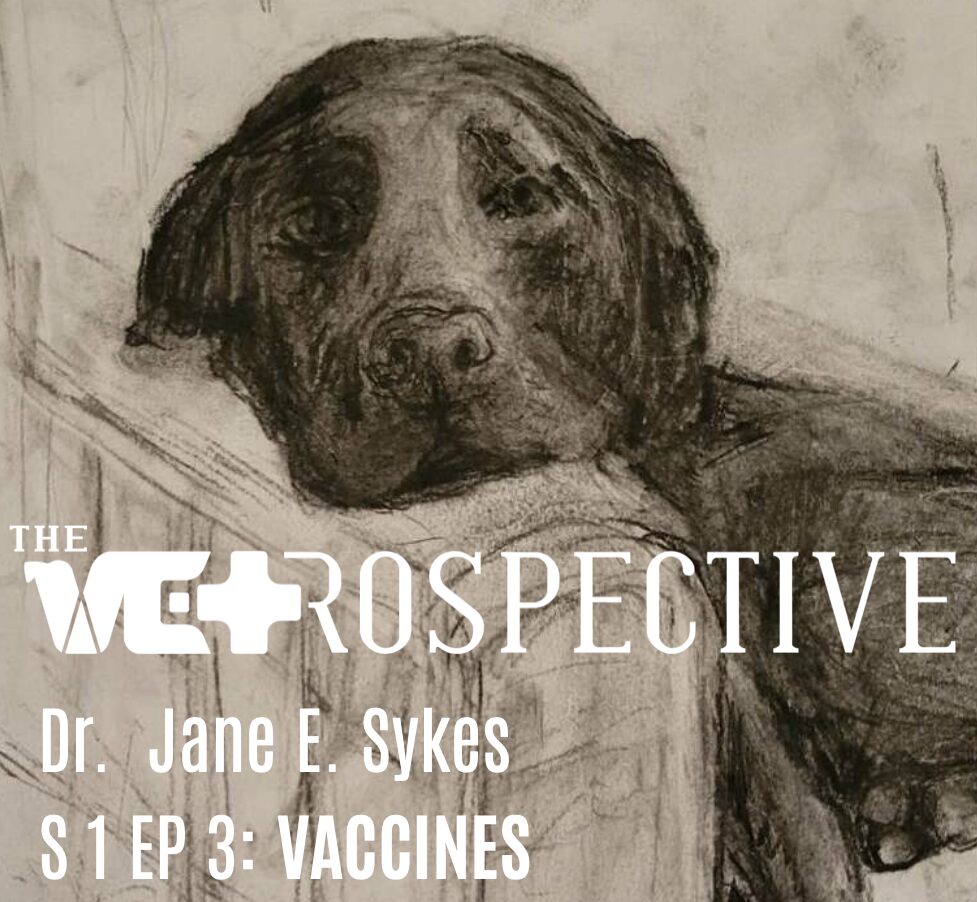
S01 E03: Vaccines


Dr. Michael Kent and infectious‑disease expert Dr. Jane Sykes explore how vaccines protect dogs and cats, from core essentials like rabies and parvovirus to emerging technologies such as mRNA. They discuss safety, vaccine hesitancy, and the exciting future of veterinary vaccine innovation.
Transcript
Dr. Sykes: I think the future looks bright for vaccines as we have new vaccine technology. And as bad as the pandemic was, one of the best things that came out of it was just innovation in vaccine design.
Dr. Kent: Welcome to today’s segment of The Vetrospective. This is your host, Dr. Michael Kent. I’m a professor at the UC Davis School of Veterinary Medicine, where clinically I practice as a radiation oncologist. Vaccines. What comes to your mind when you hear this word? The word vaccine comes from the Latin root vacca, meaning cow. So how did this happen? The name of the cowpox virus is Variola vaccinia, and back in 1796, a British physician, Edward Jenner, used this in a sense to infect or immunize people with the cow smallpox virus, which did not cause serious disease in people, but in turn protected them from smallpox, which was a serious life-threatening disease at the time.
Since then, multiple vaccines have been developed to prevent or even now treat disease. Of course, most people are familiar with vaccines available for humans, like measles, mumps, rubella, flu, and more recently, the COVID-19 vaccine. So what about vaccines for your dogs and cats? This is what we’re going to have a talk about today, a deep dive with Dr. Jane Sykes.
Dr. Sykes is a professor here at UC Davis, and she has a special interest in small animal infectious diseases, particularly of dogs and cats and those related to public health. She has published over 150 peer-reviewed scientific publications and is the editor of several textbooks on canine and feline infectious diseases. She founded the International Society for Companion Animal Infectious Diseases and has held several leadership roles in the American College of Veterinary Internal Medicine, including serving as president and board chair. She has trained over 50 internal medicine residents in her career and several clinical infectious disease fellows. She is also director of our Center for Continuing Professional Education. She speaks internationally on infectious diseases and also postgraduate veterinary education. And then just as a fun side note, she is the person behind Ask a Vet, the column she does for the Washington Post. So it’s my pleasure to have you here, Dr. Sykes. Thank you for taking the time to join me on the Vetrospective.
Dr. Sykes: Thanks for the opportunity to participate.
Dr. Kent: It’s great to have you. So I always ask this person, this person. I always ask our guests this question because I find it really interesting. We always get different answers. And why did you become a vet?
Dr. Sykes: Yeah, I kind of have the classic story. I wanted to become a vet when I was seven. So it’s kind of as far back as I can remember. I actually remember being in elementary school in the bathroom and telling somebody I wanted to be a vet. And that was kind of the turning point. And I just loved animals. But my dad was a doctor and my mother was a high school teacher. So I’ve been fortunate enough to combine those aspects of my life to become a veterinary educator.
Dr. Kent: That’s perfect. And what made you interested in infectious diseases in particular? So, you know, that’s a fairly specialized and important area, but a specialized area in veterinary medicine.
Dr. Sykes: Yeah, I was actually really became really fascinated in infectious diseases during vet school. Especially, I really enjoyed microbiology and I had a great microbiology teacher, professor, who encouraged me to pursue a PhD in veterinary microbiology. And that kind of was the beginning of my infectious disease career.
Dr. Kent: That’s very cool. So I think maybe starting with some of the basics makes sense. So could you explain to me what a vaccine is and how they work?
Dr. Sykes: Yeah. And so you’ve kind of introduced this with the story that you began with, but a vaccine is a modified or a killed or a portion of a bug. And it’s usually a virus or bacteria, and it’s given to stimulate an immune response that’s then going to protect you from natural infection.
Dr. Kent: So your body remembers this. Not real infection, and then can protect you later from exposure to it.
Dr. Sykes: Yep, exactly.
Dr. Kent: So what is the difference between, you mentioned killed and live, I know there’s modified live vaccines, and then even the new mRNA vaccines that we’ve heard so much about over the last five years.
Dr. Sykes: Yeah, so we have a lot more different types of vaccines now than there were previously. One of the classic types of vaccines is a modified live vaccine. It’s usually a virus. It’s sort of a weak virus or what we call an attenuated virus and that replicates in the body. It doesn’t make you feel really sick, but stimulates an immune response. In contrast, a killed vaccine is a completely inactivated bug that doesn’t replicate. And so usually they have additional components of those vaccines that help to boost that immune response. So often contain things like adjuvants to help stimulate the immune response or create that really strong immune response needed. You mentioned mRNA vaccines. Yeah, so those are small pieces of nucleic acid, a little bit like DNA. They’re actually copied from a DNA template. from a bug. So, this is less likely to actually cause all the same signs that an attenuated virus, an intact virus, might cause. And there was a lot of innovation in these vaccines as a result of the COVID pandemic. And now they’re actually starting to appear on the market for companion animals as well. And they’re actually great vaccines because they can be easily modified, such as when there are new strains of a virus that starts circulating. It’s much easier to scale up production of slightly different mRNA vaccines that can stimulate an immune response.
Dr. Kent: So they use the genetic code or a piece of the genetic code from the virus, let’s say, or I guess it could be bacteria as well, but I haven’t heard of a mRNA vaccine against a bacteria. And it takes that bit and replicates it in the body. And is that how we get the immune response?
Dr. Sykes: And it produces antibodies to what that codes for. And that can help to protect you from natural infection.
Dr. Kent: And I’m sorry, go ahead.
Dr. Sykes: So I was also just kind of mention that there are other types of vaccines that are even in more widespread use in companion animals. And so we have these recombinant vaccines, for example, which are used for Lyme disease is one example where we have just a little piece of protein from an organism that stimulates this.
Dr. Kent: So when you say recombinant, are you meaning that we’re taking a coding again and then somehow displaying that to the body? How would you explain that?
Dr. Sykes: Yeah, so again, these vaccines are actually produced by companies that make vaccines using a bacteria such as E. coli, for example, where they make large amounts of just a little bit of protein using that bacteria. And that’s the recombinant process that allows you to.
Dr. Kent: So kind of how we make insulin a lot of ways now.
Dr. Sykes: Yeah.
Dr. Kent: Okay. So these are not necessarily new technologies, They’re pretty proven and the like. We’re going to talk more about safety later because I think that’s a really important topic. But I kind of want to ask you first, what are the core vaccines? What are the ones, you know, we hear about core vaccines these days? What are the core vaccines for dogs and then for cats?
Dr. Sykes: So vaccines for dogs and cats are broken down into these two categories, core vaccines and non-core vaccines. The core vaccines are for every dog and cat, right? They’re important.
Dr. Kent: The essentials.
Dr. Sykes: The essentials, right? They’re either bugs that cause really severe disease, that can’t easily be treated, for example, with antibiotics, or they’re just really, really common and then they’re an important cause of what we call morbidity, just kind of not feeling very good.
Dr. Kent: Yeah.
Dr. Sykes: And then we have the non-core vaccines, which are reserved for dogs and cats that might be at greater risk for certain diseases, just as you might get vaccines for yourself if you travel to certain countries.
Dr. Kent: Okay. And so I know, like, for example, rabies is considered a core vaccine. And while rabies is nearly always fatal, for people and for animals as well, there’s a real public health concern there also, right?
Dr. Sykes: Yeah. So rabies is one really important reason for vaccinating dogs and cats in the United States. In countries where dog vaccination for rabies is not practiced, rabies is a really important public health problem as it results from transmission from dogs. In the United States, rabies is mostly a problem in wildlife like bats and raccoons and skunks and so it’s important to vaccinate dogs and cats so that they’re not likely to be infected from those wildlife species. And then, you know, when dogs and cats become infected, they can spill over to humans.
Dr. Kent: Usually a bite, right?
Dr. Sykes: That’s right.
Dr. Kent: Yeah, and so actually the fact that they are vaccinated is what keeps these spillover events from happening.
Dr. Sykes: Yeah, there was actually a really amazing story about a softball tournament in North Carolina where some kids found a kitten that was sick and they were all playing with it at the softball tournament. There were people from multiple states that came in and played with this kitten. And then over the next few days, the kitten got sick and the mother of a kid took the kitten to a veterinary clinic.
Dr. Kent: Very responsible.
Dr. Sykes: Yes, and the veterinarian actually euthanized this cat because it had bad neurologic signs. And then the mother went back home to her house and she started thinking about rabies. And she actually called the veterinarian and she said, will you test that kitten for rabies? And her veterinarian hadn’t thought about rabies, but because she called the vet, the kitten was tested for rabies and found to have it. And so as a result, hundreds of kids had to be treated with post-exposure prophylaxis.
Dr. Kent: Which is not pleasant.
Dr. Sykes: Yeah.
Dr. Kent: it’s not pleasant. I know, you know, for humans, rabies vaccine isn’t considered a core vaccine. I mean, all of us who in the veterinary field are all vaccinated for it, but the general population isn’t. So it’s a pretty scary disease if a human is exposed.
Dr. Sykes: Yeah, so you can see it still can be an important problem. It’s another reason why even indoor pets need to get vaccinated for rabies because bats can be in houses. And so.
Dr. Kent: And bats can carry it.
Dr. Sykes: Bats can carry it.
Dr. Kent: In fact, I’ve heard more of the main ways people now can get exposed is if they’re going to caves with bats and then they can actually inhale it from the of the bat feces, right? So some of the other ones that we talk about also, some of the other ones, let’s say parvovirus for dogs, you know, why is that something that we need to vaccinate for?
Dr. Sykes: Yeah, so let’s talk about dog-core vaccines.
Dr. Kent: Yeah.
Dr. Sykes: All vaccines for dogs are parvo, distemper, and adenovirus, which causes a disease called infectious canine hepatitis, in addition to rabies. One of the most common infectious diseases of that group is canine parvovirus infection, which is a severe viral disease, most commonly affects puppies, but sometimes we see it in young adult dogs that haven’t been properly vaccinated. And it causes really bad vomiting and diarrhea and dehydration and bone marrow suppression and death if it’s not treated.
Dr. Kent: Aggressively. Yeah, I remember. during my internship, I was in inner city Philadelphia and there were a lot of unvaccinated dogs coming in. And during vet school, I had never seen distemper and I had never seen parvo, but in all the unvaccinated dogs there, we regularly saw parvo and we regularly saw it on a cat, had leukopenia, diseases I had never seen before and kind of was a lesson to me on the importance of vaccination.
Dr. Sykes: One of the really important things about parvo that makes it special and makes it so successful as a cause of disease in dogs is because it can survive in the environment for very long periods of time. It can survive more than a year in the environment. So if a dog has diarrhea outside and that dog has parvo, then the virus can persist there for a very long period of time. It’s one of the reasons why we say that dogs that are getting their puppy series of vaccines should be kept relatively away from the outdoors, not just other dogs, because they can become infected during that time that they’re getting their puppy series.
Dr. Kent: Really important advice. So for the first three months or so, your dog is not really protected, right?
Dr. Sykes: That’s right. And so these vaccines that we give to puppies and kittens, they’re called a series. They’re not boosters. They’re given multiple times over a course of about 16 to 18 weeks, in order to wait for the time when puppies and kittens lose the antibody that they get from their mothers.
Dr. Kent: From the colostrum, right? Yes, when they’re nursing.
Dr. Sykes: Yeah, and so those antibodies actually stop vaccines from working properly. And so we’ve got to wait for them to disappear, but we don’t really know how long an individual puppy or kitten is going to take to lose those maternal antibodies.
Dr. Kent: So it’s important to get the whole series.
Dr. Sykes: That’s right. Yeah.
Dr. Kent: And that’s not considered a booster, like you’re saying, but that’s just the initial vaccine.
Dr. Sykes: That’s right. So we give the series. And if the last vaccine in the series is given before 16 to 18 weeks, then that puppy or kitten might not be protected from that infection. And it’s why we often give this additional vaccine at either six months or a year for those animals that still had maternal antibody at 16 weeks.
Dr. Kent: So that’s the first booster in a sense is just it is really your insurance policy.
Dr. Sykes: That’s right, yeah.
Dr. Kent: So what about cats? What are core vaccines for cats?
Dr. Sykes: Yeah, so core vaccines for cats are feline herpes virus, feline calicivirus, and panleukopenia, which you also mentioned, as well as rabies. And then for cats that are a year or younger, core is also feline leukemia virus.
Dr. Kent: Now, for feline leukemia virus, since that’s a virus that’s transmitted close quarters or direct contact. Is that an essential vaccine for a cat who’s indoor?
Dr. Sykes: Yeah, so feline leukemia virus, as you said, it’s actually shed in a cat’s saliva and so close contact among cats can transmit it. And actually bringing cats indoors promotes transmission of that virus because cats are living closely together. They’re often sharing food and water dishes, for example. There’s mutual grooming that goes on, and all of those things can serve to transmit the virus within indoor environments. And so for people who have a cat that’s not infected with feline leukemia virus, and then they might bring a new kitten into their household, there’s the potential for their existing…
Dr. Kent: Existing cat to become infected from an introduced cat from the new kitten they got, whether the shelter or breeder. You know, I know most cats are tested for this, but the tests may not detect the infection at certain points, right?
Dr. Sykes: That’s right. The tests have limitations. They can be negative if it’s very early. And then sometimes cats can go positive and negative and positive and negative. And so you can miss a positive cat sometimes with those tests. So they’re not perfect. They’re helpful. But it’s good to have the insurance from a vaccine because of that.
Dr. Kent: So now some of the core, non-core vaccines we talked about or just briefly mentioned. What about Lyme disease? Is that a vaccine that’s considered core or why not?
Dr. Sykes: Yeah, so Lyme disease, just like people, dogs can get Lyme disease. It’s not a disease that we see in cats. So Lyme vaccines are just for dogs. It’s a non-core vaccine. It’s used for dogs that are at risk. And that’s because Lyme disease has a very special geographic distribution in the United States, right? It’s most common in the Northeastern states and also in the upper Midwest. And yes, we see some Lyme disease in Northern California here, but it tends to be limited to just certain regions of Northern California. And it’s nowhere near as common as it is in those other parts of the country.
Dr. Kent: Where the ticks carry the disease, right?
Dr. Sykes: Exactly right.
Dr. Kent: And now there’s not a Lyme disease vaccine for humans at this point, is that correct?
Dr. Sykes: That’s correct. The did used to be a Lyme vaccine for people called LYMErix . And ultimately, because of controversies surrounding adverse effects of vaccination, the LYMErix vaccine was withdrawn. But there is a new Lyme vaccine that’s currently going through clinical trials. It’s looking really positive, and it’s a recombinant vaccine, like I mentioned, which is very similar to the ones that are available for dogs.
Dr. Kent: Now, I know I haven’t practiced general practice or been on the East Coast in a long time, but I know when I was, again, in my internship, we used to talk about how the Lyme vaccine at the time might actually cause worse disease in animals. So is this still the same vaccine that it was 25 years ago?
Dr. Sykes: I mean, yes, the vaccine’s very similar, but I think that there really wasn’t very good evidence to support that concern. And what’s really neat about the Lyme vaccine is that it actually works in the tick rather than in a dog. So you vaccinate your dog, it develops antibodies to the Lyme organism, Borrelia burgdorferi. And then when the tick bites your dog, it ingests those antibodies and the antibodies work in the tick. and not in the dog.
Dr. Kent: So it bites the next dog and they can’t infect it.
Dr. Sykes: And then the organism is not transmitted. So it’s actually a really cool vaccine because it’s working in the tick.
Dr. Kent: It works in a different way. So you’re almost vaccinating against the tick. So what about rattlesnake vaccine? I know that’s been controversial too at points.
Dr. Sykes: Yeah. So there is a conditionally licensed rattlesnake vaccine. This vaccine has been a little bit controversial and the studies that have looked at it have shown, in some case maybe that it is beneficial and other studies not, but the studies haven’t been very large studies. So I don’t think we have great studies out there to be able to make a conclusion.
Dr. Kent: Yeah, that’s right. And you know, rattlesnakes are around us here in Northern California, but they are not really that widely spread throughout the US. So it’d be a regional vaccine regardless.
Dr. Sykes: Definitely like a non-core vaccine. There’s also been some concerns about allergic, bad allergic reactions to that vaccine. It’s especially been seen in animals that got the vaccine and then got bitten by a rattlesnake.
Dr. Kent: And now I was going to ask you about Bordetella, which is something for dogs that is often required by kennels if you’re going to board the dog. So what’s the effectiveness of that vaccine and should it be given to dogs who aren’t going to necessarily be boarding?
Dr. Sykes: So Bordetella is again a non-core vaccine. It’s really reserved for dogs that are likely to be exposed to pathogens that cause canine infectious respiratory disease.
Dr. Kent: What we call kennel cough.
Dr. Sykes: Yeah. So it’s, definitely dogs that are going into doggy daycare environments or be you boarded. Dogs that contact other dogs, like in dog parks, potentially could get infected. But most of these respiratory diseases are going to be best transmitted in indoor type environments where dogs are congregated.
Dr. Kent: Yeah. Is Bordetella the only agent that causes Kennel cough.
Dr. Sykes: No, there’s actually at least 17 different bugs that could cause.
Dr. Kent: So it’s not necessarily going to be fully protective either, but it’s the portion we can vaccinate for, right? For, yeah. Not the number four, but what we can vaccinate for.
Dr. Sykes: Yeah, there’s lots of different viruses and bacteria that can cause that disease.
Dr. Kent: And I know I’m making this a laundry list, but I’m I think it’s pretty interesting to go through these, so I hope you don’t mind. What about canine influenza?
Dr. Sykes: Yeah, so canine influenza, there’s two different types of canine influenza that we have vaccines for. One is the H3N8 type, and one is the H3N2 type.
Dr. Kent: So those are just designations for the type of influenza or flu. Just naming them, right?
Dr. Sykes: Yeah, just like we’ve been talking about H5N1 viruses circulating. We don’t have an H5N1 vaccine, but these vaccines for influenza are subtype specific. So they are only going to protect against that subtype, which is why we’ve had these two different vaccines for dogs. The H3N8 virus, though, which emerged in the early 2000s and actually jumped from horses to dogs, was mostly a problem in shelters. And now it’s believed that that’s extinct in the United States. So we really probably don’t need vaccines for H3N8 anymore. But the H3N2 virus keeps getting brought back into the United States from dogs in Asia, especially Korea and China. And we keep getting reintroductions of that virus, which then causes outbreaks. again, oftentimes in shelters, but sometimes it can spread to the community.
Dr. Kent: So is that, that’s why it’s not a core vaccine, because it’s not a pandemic or epidemic in a sense, it’s just sporadic infections in the US. Is it serious enough that you should consider getting your dog vaccinated if you’re, let’s say, in an area with, you know, a lot of dogs? et cetera.
Dr. Sykes: I mean, I think if your dog mingles with a lot of other dogs, again, indoor environments is going to be the most common way, then there’s a reason to vaccinate. So usually dogs that are getting Bordetella should also get H3N2.
Dr. Kent: There’s also some non-core vaccines for cats. And we actually are having Dr. Terza Brostoff on to talk about FIP and we’ll be talking about FIP vaccines on a different episode, but maybe you could run through some of the non-core vaccine for cats and how effective they are and which cats might be best, vaccinated with them.
Dr. Sykes: So first of all, I’ll talk about FeLV and FeLV for cats older than a year of age is a non-core vaccine. The thing about FeLV is when cats get older, when they get to adult age, their own immune system protects them well from that viral infection. So it’s mostly going to be cats that are really at risk of exposure to the virus, especially cats that go outdoors and could encounter other cats that might be shedding at FeLV, because that FeLV can be transmitted through biting as well. So non-core for cats older than a year of age, but because we really often don’t know what people are going to do with kittens, it’s core for cats under a year of age.
Dr. Kent: Yeah, and then let’s just jump to FIV.
Dr. Sykes: Yeah, so there is no vaccine available for FIV anymore in this country?
Dr. Kent: Just like the HIV there isn’t.
Dr. Sykes: Yeah, and there used to be one here, actually, it was discontinued about seven or eight years ago now. And one of the problems with that vaccine, in addition to it not working very well for all strains of FIV, It also interfered with diagnostic testing for infection. And we still have some cats that were vaccinated seven years ago that have antibodies from vaccination that test positive for the disease and we still are struggling with that even now. So there’s no FIV vaccination in the US. There is in other countries like Australia.
Dr. Kent: Yeah, And are there other vaccines I’m missing for cats? I think there’s like for There are a few others, maybe you could touch on those.
Dr. Sykes: Yeah, so we also have a Bordetella vaccine for cats. And we also have a chlamydia vaccine for cats. And chlamydia causes conjunctivitis, runny eyes, and sometimes sneezing in cats. It’s a respiratory pathogen. And those Bordetella and chlamydia vaccines, mostly probably in young cats and catteries, so typically reserved for those cats. And then we’ve had a somewhat controversial FIP vaccine, which I think you’re probably going to talk about with Dr. Brostoff.
Dr. Kent: Yes.
Dr. Sykes: Our current FIP vaccines are not very effective.
Dr. Kent: Not effective. Problematic, yeah.
Dr. Sykes: One of the other vaccines that’s really important and that has recently had a change in recommendations is the lepto vaccine for dogs.
Dr. Kent: Actually, I meant to ask you about that because that’s something that I know changed over the years.
Dr. Sykes: Yeah.
Dr. Kent: And so lepto or leptospirosis, that’s a bacteria that can cause kidney infections, right?
Dr. Sykes: That’s right. It’s A bacterial infection. It’s transmitted in urine and often wildlife or domestic animal reservoir hosts like cattle and sheep and horses can shed this virus, this bacteria ,in their urine. And then that can contaminate water sources and dogs can get infected through exposure to those water sources or through eating rodents. And actually rodents are the most important reservoir hosts for lepto, like, there’s a one in three chance that a brown rat that you see is shedding lepto. Yeah, really common.
Dr. Kent: Which is also a public health concern, right? I mean, because people are susceptible to this bacteria also.
Dr. Sykes: People can get lepto and it’s become a big issue in big cities where there’s been rodent overpopulations recently.
Dr. Kent: Because most of the time viruses don’t jump between species easily, but bacteria is bacteria and infects everyone. So like rabies is kind of the exception, right? Where rabies infects all mammals and it’s one virus. But leptospirosis really affects any mammal.
Dr. Sykes: Any mammal, even people. And actually any mammal can just look perfectly healthy and be shedding lepto in its urine, including people.
Dr. Kent: And sometimes you’re clinical for it and sometimes you’re not. Let’s say you are infected and you’re susceptible to this infection. What’s the consequence of it being affected?
Dr. Sykes: Yeah, so when it causes disease, like you mentioned, it causes severe kidney disease and also liver problems, but any organ in the body can be affected. It can cause lung problems, gastrointestinal problems, even involve the brain. So it’s a multi-systemic disease. it can be fatal if not treated aggressively.
Dr. Kent: So now there’s different forms of leptospirosis or serovars, I think they’re called, right? So how good is the vaccine at protecting dogs, cats from… from this disease.
Dr. Sykes: So these different serovars all have different outer coatings and the vaccines only protect against the seravar that they contain. So our lepto vaccines for dogs have four different serovars in them. So to protect against at least those four different seravars.
Dr. Kent: And are those the most common serovars out in the environment?
Dr. Sykes: We actually don’t know, but we do know that the vaccines stop dogs from getting disease because dogs that are vaccinated for lepto don’t get sick. And so we’ve actually been studying a really interesting outbreak of lepto in Southern California that involved over 200 dogs in the West Los Angeles area. And so people got to know about this outbreak, which was connected to a couple of doggy daycares in the area. And they were actually going to their vets and saying that they’d heard about this outbreak and they wanted their dogs to be vaccinated for Lepto. But because Lepto wasn’t a core vaccine and the practitioners in that region were not vaccinating for Lepto, they didn’t even have the vaccines in stock.
Dr. Kent: Wow.
Dr. Sykes: And so they started vaccinating because of owner demand, because they learned about this outbreak and were worried about their pets. And now Lepto is recommended as a core vaccine. So since that outbreak occurred, the recommendations have changed from non-core to core. So every dog, every year, lepto.
Dr. Kent: And how effective is it? Like you said, it will stop disease.
Dr. Sykes: Yeah, and like I said, like we have not seen lepto, basically not diagnosed lepto in dogs that have been fully vaccinated for lepto. All the dogs that we diagnose here at UC Davis have not received lepto vaccines.
Dr. Kent: You brought up another point, which I’m just going to shift our conversation a little bit. You said every dog lepto vaccine every year. So now the question of how often do we vaccinate? Should all these vaccines be given yearly? How do you determine how often a booster is needed? You know, because there’s concerns about over vaccinating or vaccinating too often.
Dr. Sykes: Yes. So this is a really good question. And for these bacterial vaccines, the ones that are, that use killed vaccines or recombinant vaccines, where you.
Dr. Kent: So Bordetella is bacterial or viral.
Dr. Sykes: So Bordetella is a bacterial.
Dr. Kent: Bacterial. So that’s a yearly one.
Dr. Sykes: Yes, although it’s also a respiratory vaccine, and so the respiratory pathogens usually need yearly vaccination.
Dr. Kent: And then lepto is a killed bacterial, so we need that yearly.
Dr. Sykes: Yes.
Dr. Kent: And what else?
Dr. Sykes: So Lyme would be another example that’s a recombinant or killed vaccine that has to be given yearly as well.
Dr. Kent: Okay.
Dr. Sykes: But now we have a core vaccine that’s an annual vaccine, whereas in the past, our modified live viral vaccines, our distempo Pavo vaccines, herpes, calici and cats, we were giving every three years.
Dr. Kent: Yeah, and even rabies is every three years. After the first booster. Yeah.
Dr. Sykes: So that’s a major shift, right? Because for dogs that were just getting core vaccines in the past, they were coming in every three years for vaccination. But now because lepto is core, all of those dogs are coming in yearly to get the lepto vaccine.
Dr. Kent: That’s a big shift. That’s a big shift. And so do we still need to do every three years, let’s say for the parvo and distemper and parainfluenza, those cores, does the protection only last three years?
Dr. Sykes: Yeah, so for parvo and distemper and adenovirus, the three organisms that are core in dog vaccines, really those vaccines are going to probably provide lifelong vaccination once the puppy series has been completed, so long as you got that last vaccine at the right time, probably it’s going to be lifelong immunity. The recommendation still is every three years, the vaccines are really safe and unlikely to cause side effects. So it’s felt that three years is appropriate at this time. But I think in this era of vaccine hesitancy, we are starting to think about some of those vaccines like parvo and panleukopenia and whether those ones which have really strong long duration of immunity, do they really need to be given every three years? Still the recommendations from AAHA and WSAVA is that they’d be given every three years.
Dr. Kent: And those are some of the main veterinary groups that look at this. Yeah. So is there other ways that you can tell if you’re still protected? You can run some blood tests for that.
Dr. Sykes: Yeah, so there are tests that are available to look for antibodies, but if you don’t have antibodies, it doesn’t mean that you’re not protected. And so I think also these vaccines have become so safe in recent years with improvements in vaccine technology that there’s such a low risk of having any sort of side effects from them ,that it’s better to vaccinate.
Dr. Kent: So now I really wanted, I want to take this conversation in two directions based on what you said. Now I can’t decide which to do first, so I’ll let you choose. I want to talk about vaccine hesitancy, but I also want to talk about the safety of vaccines. So maybe let’s talk about safety of vaccines first. I’m going to take that from you, sorry. And then we’ll talk about vaccine hesitancy, because that’s something that’s come up more and more. So what are the risks of an allergic reaction to a vaccine?
Dr. Sykes: Yeah, the risk of any sort of allergic reaction is extremely low, like less than 0.5%. Maybe even less than 0.1% for some vaccines. But the risk is not even. Like there are some animals that are more likely to have reactions than others. And remember that a vaccine is designed to produce an immune response.
Dr. Kent: Yes.
Dr. Sykes: It’s designed to cause inflammation. And so it’s normal to have a little bit of a fever, you know, and pain at an injection site, just like we all do when we get vaccinated. A vaccine is supposed to produce an immune response. So we’ve kind of got this balance between wanting to create inflammation and immunity and wanting to minimize the side effects of those. Most reactions in dogs and cats are going to be soreness at the vaccination site or sometimes just a little nodule, local reaction, bump, at the vaccination site. Really rare are these sort of anaphylactic type reactions that people worry about where animals can get, you know, swollen faces or they can collapse and need emergency treatment.
Dr. Kent: And that was more common. decades ago, right? With some of the formulation of the vaccine. So that’s, do you think some of that’s holdover from old knowledge?
Dr. Sykes: Yeah, I mean, we still, we still see them. I still talk to practitioners on a regular basis who have seen allergic anaphylactic type reactions. So they’re not, you know, completely gone, but they’re certainly less frequent now than they were decades ago.
Dr. Kent: And they’re treatable, right?
Dr. Sykes: Yeah.
Dr. Kent: So What about autoimmune disease? Because I’ve heard people talking about that too. the concern that over vaccinating or repeated boosters can cause autoimmune disease in dogs.
Dr. Sykes: Yeah, there’s actually been quite a lot of studies looking at this and no link between vaccination and autoimmune disease. We have not found a connection, proven connection, between vaccines in dogs and cats and autoimmune disease. However, for dogs and cats that have been diagnosed with autoimmune disease, which is more common in dogs and in cats, so cats rarely get autoimmune diseases. I say cats don’t like to self-destruct, worse dogs self-destruct a lot more often. So for those dogs that have, you know, had autoimmune hemolytic anemia or autoimmune joint disease, If those animals have been controlled with the drug therapy that they’re in remission and their signs are being controlled, I think it is possible for a vaccine to then sort of disrupt that balance and they can.
Dr. Kent: Re-stimulate the immune system, which may include stimulating the immune system against your own body.
Dr. Sykes: Yeah
Dr. Kent: So that’s something that you would talk to your vet about, the benefits and risks and maybe consider holding off on the vaccines where possible. So for cats though, there is a real risk. We see injection site sarcomas, being an oncologist, I still see those, though much less frequently than we used to. So the risk is very low. I’ve seen numbers saying anywhere 1 in 10,000, 1 in 50,000. No one really knows how commonly they occur, but they do. Even with the new reformulated vaccines, We still see them on occasion. So how do you balance the risk for infectious disease versus that’s a true potential side effect of a vaccine?
Dr. Sykes: Yeah, you know, I think that the risk of injection site sarcomas is really a lot lower than it used to be.
Dr. Kent: I agree with that, but it’s still there, but it’s lower.
Dr. Sykes: I don’t know. I think that, yes, it’s a risk, although extremely low. And I think that these infectious diseases like panleukopenia are really severe. Feline leukemia is a horrible disease. We see it all the time.
Dr. Kent: I mean, both of those could be fatal. And panleuk is almost always fatal, right?
Dr. Sykes: Yep. And calici and herpes are a really big problem in the cat population. They cause bad respiratory diseases. So I think the risks of injection site sarcomas are outweighed by the severity and frequency of these infectious diseases.
Dr. Kent: So now I’m, this may be a little bit of a loaded question. I’m not trying to bait you or maybe I am, but what about the risk of autism in pets after vaccination? I’ve heard this is a concern that’s been raised.
Dr. Sykes: Yeah. So can I actually just back up a little bit on the injection sites?
Dr. Kent: Oh yeah, please, And then you can answer that question.
Dr. Sykes: So one other thing that I have to say about injection sarcomas is that owner awareness of this issue is very important.
Dr. Kent: Yeah.
Dr. Sykes: And so the reason for that is that then owners can be monitoring injection sites, not just vaccines, but other injections for any little lump that appears at the site and early diagnosis of injection is going to lead to much better outcomes than if they’re left.
Dr. Kent: Definitely, important. So if you see a persistent lump at the site of an injection, you need to go in and have it checked is what we tell people. And we want to make sure because it could be a fairly small surgery if you catch it very early as opposed to needing surgery, radiation, and chemotherapy if it goes later and we may not be able to control it. So definitely thank you for bringing that up.
So what about the autism question?
Dr. Sykes: Autism, and I wasn’t trying to skip that one.
Dr. Kent: Maybe you should.
Dr. Sykes: But yes, I mean, there has actually been some studies that suggest that some people might believe that vaccines in pets can cause autism, but dogs and cats don’t get autism. So there’s been no connection between vaccination and actually any sort of cognitive problem in dogs or cats. One of the problems with vaccination is because pets are vaccinated quite frequently, like every year, and especially in young dogs where they’re getting vaccinated.
Dr. Kent: Multiple vaccines, yeah.
Dr. Sykes: It’s difficult to separate vaccination from disease that might just be occurring anyway, right? So your pet could get a vaccine because it’s being vaccinated every single year. And then a few months later, it could develop diabetes or some other condition. And you might be tempted to say that the vaccine caused that when it just was just a coincidence. So it’s sometimes difficult to disconnect the vaccination for a problem that occurs after vaccination. And yes, there’s been concerns about autism and diabetes and other things, but there’s absolutely no proven link to any of those problems.
Dr. Kent: So I wanted to just quickly ask also is, should a pet get multiple vaccines at the same visit or does that make them less safe or is there more risk with that?
Dr. Sykes: Yeah, and actually it’s very common for vets in practice to try to spread out vaccine components to try to reduce the risk of having a reaction. So spread it out in time, in other words, rather than on a pet’s body.
Dr. Kent: Yes.
Dr. Sykes: But really we recommend that now with the vaccines are so much safer than they used to be, it’s better to use the opportunity to vaccinate your pet and give multiple vaccines at the same time. Using combination vaccines is recommended, just like they are used in human medicine. The problem with spacing them out is if you give vaccines too close together, the immune response to one vaccine can interfere with the immune response to the next vaccine. So when vaccines are spaced out, like for example, I’ll give one vaccine this week and another vaccine next week, then you might not get an immune response to the second vaccine.
Dr. Kent: Because your body’s already busy in a sense, fighting off this non-existent infection from the first vaccine.
Dr. Sykes: Exactly.
Dr. Kent: So I saw this, I tried to do a little research before talking with you, so I don’t sound entirely stupid, but I saw this 2023 study that was published in the journal Vaccine that says about 45% of dog owners now think vaccines are unsafe. 20% think they’re not effective and 30% don’t think they’re necessary, which I was kind of shocked when I read this. And I’m sure you’ve heard this, but what are your thoughts? What do you think is behind this? Why have we lost confidence in a large portion of the pet owning population?
Dr. Sykes: Yeah, so I think first of all, just got to be a little bit careful with some of the studies. They have different populations that are being surveyed and so there may be some biases and, response biases in that are choosing to do the survey because I am concerned about vaccination. Therefore, it’s not representative of everybody.
Dr. Kent: Of all of America.
Dr. Sykes: Yeah, that’s right. And we also know from other studies that people really, they have a lot of confidence in veterinarians’ advice. And when veterinarians make recommendations surrounding vaccination, you know, people do tend to believe them and they’re, They are very, veterinarians can be very helpful in choosing vaccine protocols. So I think that’s the caution. But yes, there has been concern about vaccine hesitancy, especially along with the vaccine hesitancy for human vaccination and some evidence of spillover into pet owners.
Dr. Kent: Into veterinary medicine, it is happening as well. And What’s the danger to our pets for that, to our dogs, to cats? is this a real problem? I know we hear about, measles outbreaks in humans now. And does this bode poorly for us in the veterinary world?
Dr. Sykes: Yeah, I mean, it’s not good. And I think that, I think first of all, rabies is a public health issue. makes vaccination of pets essential. And of course, it’s required by law. And for cats in many states, it’s required by law as well. So we have the legal need for vaccination. And many people don’t know that rabies vaccines are required by law for cats in many states.
Dr. Kent: Yeah, and actually the penalty for not vaccinated, depending on your particular county, if your dog or cat bites someone and they’re not vaccinated, it could be quite severe, can either lead to long quarantines or even in euthanasia, forced euthanasia. So that’s obviously very important from public health perspective as well.
Dr. Sykes: And then for the organisms like parvo that don’t cause human disease, I actually know people who had vaccine hesitancy and didn’t vaccinate their puppies for parvo and their dogs got parvo and died. So.
Dr. Kent: Gosh, that’s terrible.
Dr. Sykes: You know, it’s a bad disease and it’s really common.
Dr. Kent: Well, and it’s expensive. Like even if you have pet insurance, it can be thousands, many, thousands to get a dog through parvo. And not easy. So I don’t want to end on kind of a sour note, but if you could make a vaccine today for an infectious disease that we don’t currently have, an effective vaccine, what disease would it be for? And why?
Dr. Sykes: Yeah, so for cats, I would say FIP. Gosh, yes. You know, even though we have antivirals now that are very effective, vaccines that work for FIP are really needed.
Dr. Kent: And our team is working on one, and we’ll be talking more about that with Dr. Brostoff.
Dr. Sykes: Awesome. And then for dogs, a couple of organisms. One’s Ehrlichia canis, which is a tick transmutative bug that is actually one of the most common infectious diseases of dogs worldwide next to parvo. And, a challenging organism to develop vaccines for, but that would definitely be something that, for dogs can be very hard to treat in some cases. I would say also globally, leishmania, which is a protozoal disease, that’s also a public health problem. And then for fungal diseases, the one that I study, which is Valley Fever. There’s vaccines in development right now for that, which would be the first fungal disease vaccine ever available.
Dr. Kent: Yeah, I hadn’t heard of that. That’s pretty cool. So what is the future of vaccines? What do you… see where we’re headed? What do you think our future holds for us?
Dr. Sykes: Yeah, you know, I think we’ll see, we’ll continue to see better and safer vaccines and new vaccines for like some of those organisms I was talking about. I think the future looks, looks bright for vaccines as we have new vaccine technology. And as bad as the pandemic was, one of the best things that came out of it was just innovation in vaccine design. So I’m hopeful that we’ll also have lepto vaccines that protect against all strains.
Dr. Kent: All serovars, all strains, yes.
Dr. Sykes: I think that will happen too. So we’ve got lots of optimism.
Dr. Kent: I like that. Being an oncologist, I like to say that I’m an optimist by nature. And so Dr. Sykes, thank you for taking the time out to speak with me and for our listeners. From the Vetrospective, it’s an honor having you on.
Dr. Sykes: Thanks for the opportunity to talk to you about vaccines.
Dr. Kent: The Vetrospective, as with life, takes a village. I want to thank those who suggested I start this project and everyone who has encouraged and supported me along the way. Particularly, I want to thank our producer and director, Danae Blythe Unti, Nancy Bei, who is our program coordinator, our sound mixer, Andy Cowitt, and theme music was composed and produced by Tim Gahagan. Thank you all, and we’ll see you next time.